
Stormwater Management & BMP Compliance in Columbia, SC
BMP maintenance, pond dredging, erosion control, and SCDES compliance support for Midlands properties sitting on Piedmont clay at the Congaree confluence.
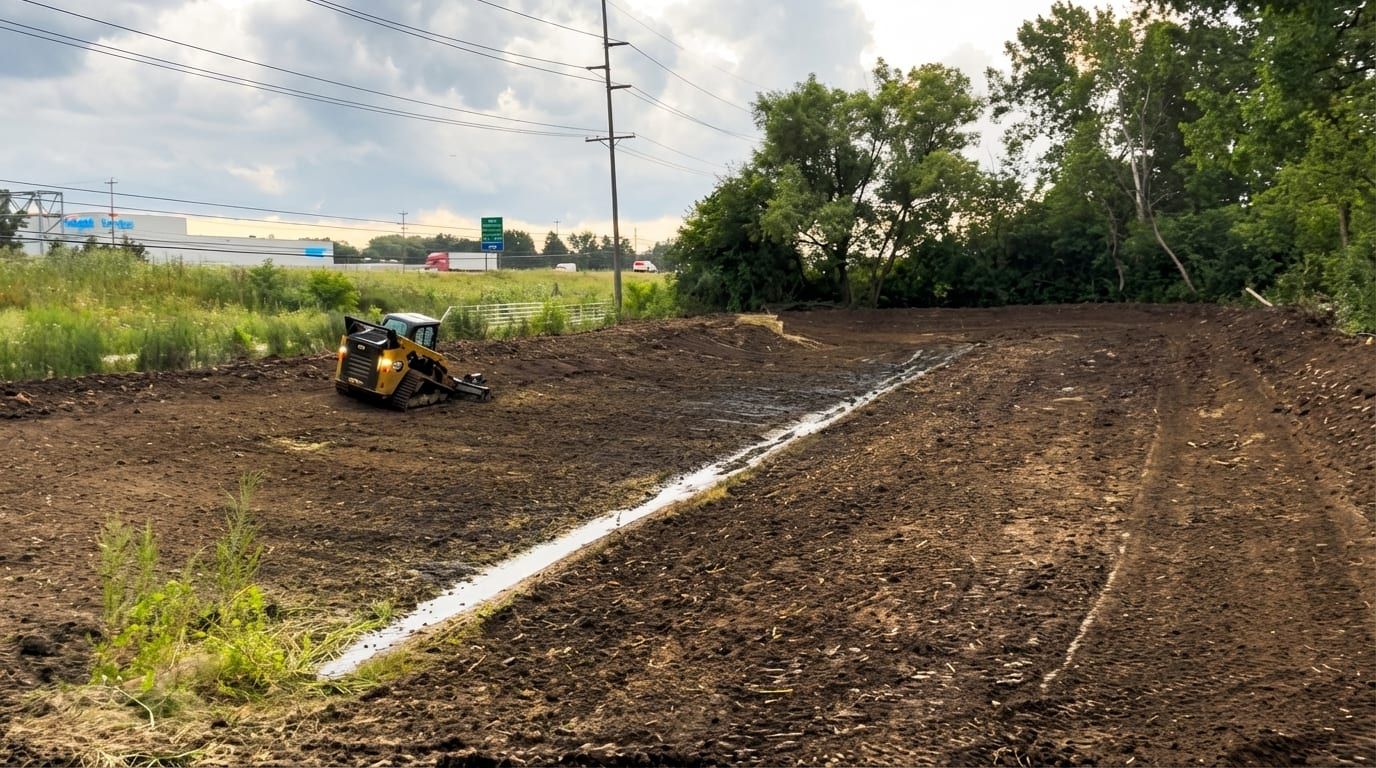
Columbia runs its own MS4 permit, and Midlands clay changes how BMPs behave.
South Carolina issues only three individual medium MS4 permits in the whole state: one to the City of Columbia, one to Greenville County, and one to Richland County. That's a different regulatory posture than a small MS4 covered by a general permit. It means the City of Columbia has its own negotiated stormwater management program, its own inspection priorities, and its own enforcement track record, separate from the general permit that covers most small municipalities. Richland County runs a parallel program for unincorporated land outside city limits, so a property's exact jurisdiction, city or county, depends on which side of the annexation line it sits on.
Where that authority sits shifted in 2024 as well. SCDHEC split into two agencies on July 1 of that year, and every stormwater function, MS4 permitting, construction general permits, industrial stormwater, moved to the newly created South Carolina Department of Environmental Services (SCDES). Existing permits carried over without reapplication, but the paperwork trail moved: applications and BMP guidance now live at des.sc.gov, and since May 2025 the state's ePermitting system requires a signed Certifier Agreement before a new stormwater application can go in.
If your property in the Columbia metro carries a stormwater pond, detention basin, or other engineered BMP, the maintenance obligation looks like this regardless of which permit covers it:
- Documented inspections of every stormwater control measure on the property
- Sediment removal and structural repair before deficiencies compound
- Records that hold up when the city or county inspector asks for them
- Corrective action on a timeline, not an open-ended maintenance backlog
What makes Columbia's maintenance work different from coastal South Carolina is what's underfoot. The Midlands sit on Piedmont clay rather than sandy coastal soil, and clay drains slowly and compacts under repeated wet-dry cycles. That means ponds hold standing water longer after a storm, pond banks are more prone to slope failure when they stay saturated, and sediment stays suspended in the water column longer before settling, so it travels farther downstream. The Rocky Branch and Gills Creek watershed management plans both identify sediment control as a specific local priority for exactly this reason.
Then there's geography. Columbia sits at the point where the Broad and Saluda rivers converge to form the Congaree, and that confluence governs base flood elevations and backwater conditions across a wide stretch of the metro, including low-lying ground near downtown and along Gills Creek. A storm drain that discharges toward the Congaree can back up during high river stage even after local rain has cleared, a failure mode coastal outfall systems don't share. Columbia found out exactly how severe that combination can get in October 2015, when parts of the Midlands recorded rainfall exceeding a 1,000-year statistical frequency and the city broke its all-time records for one-day, two-day, and three-day rainfall.
What we do for Columbia-area properties.
Stormwater BMP Inspection & Maintenance
Inspection, sediment removal, outlet structure repair, and compliance documentation for retention ponds, detention basins, and bioretention systems built on Midlands clay. SCDES's MS4 framework puts the maintenance obligation on the property owner, and we document it the way an inspector expects to see it.
Pond Dredging
Sediment accumulates faster and settles more slowly in clay-heavy watersheds like Gills Creek and Rocky Branch. We dredge stormwater ponds and detention basins that have lost capacity to sediment buildup, restoring design volume rather than patching around it.
Erosion Control
Pond bank stabilization, slope repair, and native plantings engineered for Piedmont clay, which fails differently than sandy coastal soil when saturated. We build erosion solutions for the way clay actually behaves under repeated wet-dry cycles.
Storm Drainage
Catch basin repair, storm pipe replacement, and outfall clearing for drainage systems that discharge toward the Congaree, Broad, or Saluda. Backwater conditions during high river stage are a real factor in how Columbia-area outfalls perform, and we account for it.
Grading & Earthwork
Site regrading, swale reshaping, and drainage correction. Clay soil holds a grade differently than sand, and small elevation errors on Midlands sites tend to show up as standing water rather than gradual infiltration.
Stormwater Compliance
Documentation and corrective-action support for property owners navigating SCDES's MS4 framework, whether the property answers to the City of Columbia's individual permit or Richland County's separate program for unincorporated land.
Properties we serve in the Columbia area.
HOAs & Residential Communities
Columbia's suburban growth over the past two decades, from Northeast Columbia to Lexington County communities near Lake Murray, added stormwater ponds and detention basins that carry ongoing maintenance obligations. We help HOA boards stay ahead of inspections rather than reacting to a notice of violation.
Commercial & Office Properties
Columbia's commercial corridors along I-20, I-26, and Two Notch Road carry stormwater systems subject to the same maintenance standards as any other permitted site. We handle inspection, documentation, and physical repair for commercial property owners and managers.
Multifamily & Mixed-Use Developments
The Vista, Five Points, and the corridor near USC have seen sustained multifamily and mixed-use development, much of it built on tighter urban lots where BMP capacity is already constrained. We work within those footprint limits rather than treating every site like open ground.
Municipal & Institutional
Public infrastructure, school campuses, and institutional properties throughout Richland and Lexington counties require stormwater compliance under either the City of Columbia's or Richland County's MS4 program. We support inspection cycles and capital repair work for public and institutional clients.
We come to Columbia knowing the ground and the paperwork, not learning them on your job.
AUE Land doesn't have a yard in Columbia. We're based in Bluffton and reach the Midlands through regional dispatch, a crew and equipment mobilized for the project rather than a standing local presence. What we bring instead is a working understanding of this metro's regulatory and physical conditions before we ever show up on site: the difference between the City's individual MS4 permit and Richland County's separate program, where SCDES's post-restructuring ePermitting changed the process, and why a BMP built on Piedmont clay needs a different approach than one built on coastal sand.
Every Columbia-area project starts with a site assessment, so the crew that arrives already knows what the soil, the watershed, and the permit require, not a generic stormwater playbook applied to unfamiliar ground.
Nearby areas we serve.
Upstate metro, roughly two hours northwest
Lexington County side of the metro, across the Congaree
Lexington County, along the Congaree River
Growing Lake Murray-area suburb
Roughly ninety minutes north
Frequently Asked Questions
Does the City of Columbia hold its own stormwater permit, or does the county cover it? expand_more
What happened to SCDHEC, and does that change stormwater compliance in Columbia? expand_more
Why does Columbia's clay soil make BMP maintenance different from coastal SC? expand_more
Does Columbia's location at the Congaree, Broad, and Saluda confluence affect local drainage? expand_more
Does AUE Land have a local office or yard in Columbia? expand_more
Ready for a site that thrives?
Request a site assessment and we'll evaluate your BMPs, drainage, and compliance status against Columbia's and Richland County's requirements. No obligation to hire AUE Land for any service work.
fact_check Site Health Audit
No obligation to hire AUE Land for any service work.