
Stormwater Management & Erosion Control in Traverse City, MI
BMP maintenance, erosion control, and drainage repair for Grand Traverse County properties, from a team that understands Michigan's county-administered permit structure and its freeze-thaw failure modes.
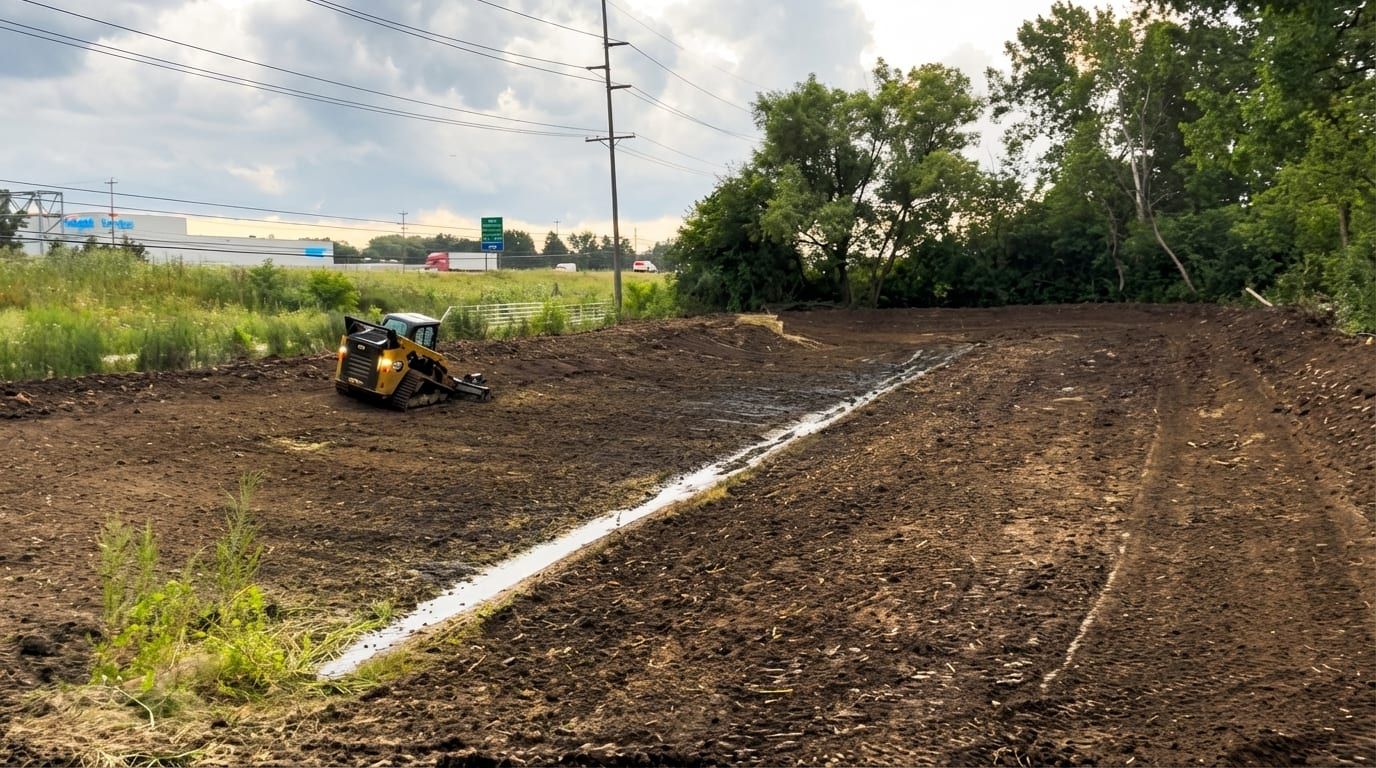
Grand Traverse County runs its own permit program under state law, and freeze-thaw does the rest.
Michigan doesn't regulate soil erosion the way Southeastern states do. Instead of a state agency issuing permits directly, Part 91 of the Natural Resources and Environmental Protection Act (NREPA) hands enforcement to a County Enforcing Agency in each county, appointed by the county board and overseen by the Department of Environment, Great Lakes, and Energy (EGLE). Grand Traverse County has adopted its own Soil Erosion and Stormwater Runoff Control Ordinance to carry out that responsibility. A permit is generally required for any earth change disturbing one acre or more, or occurring within 500 feet of a lake or stream, and near the Boardman River or Grand Traverse Bay, the 500-foot trigger catches a lot of small projects.
Grand Traverse County also has an elected Drain Commissioner's office, operating under Michigan's Drain Code of 1956, a mechanism with no equivalent in the Southeastern coastal counties AUE Land has historically served. County drains are established, legal water conveyance systems, and a property inside a drain district can carry maintenance or assessment obligations tied to that drain, separate from any Part 91 permit on the same site.
If your property involves water beyond a standard stormwater basin, two more state programs come into play:
- Part 301, Inland Lakes and Streams, which requires an EGLE permit for dredging, filling, or structures on the bottomlands of a lake or stream, and for anything that interferes with natural flow
- Part 303, Wetlands Protection, which applies if the work touches a regulated wetland
- Grand Traverse County's local ordinance, which layers additional review on top of both when the site is inside the county
Grand Traverse Bay itself is under real water quality pressure. Excess sediment and phosphorus from stormwater runoff are the two threats the Watershed Center Grand Traverse Bay identifies as the leading causes of degraded bay water quality, and the bay's watershed drains close to 1,000 square miles across Antrim, Grand Traverse, Kalkaska, and Leelanau counties. Traverse City is the largest municipality in that watershed, which puts extra scrutiny on any property whose drainage eventually reaches the bay.
The Boardman River, which flows through the middle of Traverse City, has been the site of one of the largest dam-removal restoration efforts in Michigan history. Three dams, Brown Bridge, Boardman, and Sabin, have come out since 2012, reconnecting roughly 160 miles of river and tributary habitat. Conservation groups increasingly use the name Boardman-Ottaway River, restoring the river's original Ojibwe and Odawa name alongside the more recent Boardman, though the change has not been formally finalized by federal naming authorities as of this writing. Whatever it's called, the restored, free-flowing river changes hydrology, bank stability, and flood behavior along its corridor in ways a still-dammed river wouldn't.
Then there's the season Southeast contractors never plan for. Michigan's winter freezes and thaws its soil repeatedly rather than freezing once and staying frozen, and the region's clay-heavy subsoils hold water tightly enough to make that movement worse. Frost heave shifts culverts and catch basins out of alignment over the winter. Spring melt then pushes a concentrated pulse of water through pipe joints and outfalls that spent months being stressed by ground movement, which is exactly when hidden damage turns into a visible failure.
What we do for Traverse City area properties.
Stormwater BMP Inspection & Maintenance
Inspection, sediment removal, outlet structure repair, and documentation for detention basins, bioretention areas, and other engineered stormwater controls, built to satisfy Grand Traverse County's Soil Erosion and Stormwater Runoff Control Ordinance and Part 91 recordkeeping.
Inland Lake & Pond Maintenance
Sediment and vegetation management for resort ponds, stormwater retention ponds, and riparian frontage on Grand Traverse County's inland lakes. Work that touches lake bottomlands or connects to a lake or stream falls under EGLE's Part 301 permit program, and we scope projects with that in mind from the start.
Erosion Control & Bank Stabilization
Streambank and shoreline stabilization for properties along the Boardman River corridor, Grand Traverse Bay frontage, and inland lakeshores. Sandy glacial soils and steep bluff topography around the bay make bank failure a recurring problem once vegetation cover is disturbed.
Storm Drainage Infrastructure
Catch basin repair, culvert replacement, and outfall restoration for systems damaged by frost heave and spring melt loading. Northern Michigan's freeze-thaw cycle attacks buried infrastructure in ways coastal Southeast systems never encounter, and repairs need to account for it or they fail again the following winter.
Grading & Drainage Correction
Site regrading, swale reshaping, and drainage redirection for resort properties, seasonal communities, and commercial sites around Traverse City. Rolling glacial moraine topography and clay-heavy subsoils change how water moves across a site compared to flat coastal ground.
Emergency & Post-Storm Repair
Washout repair, culvert failure response, and outfall stabilization following spring melt events or heavy summer thunderstorms. Scheduled as a project mobilization rather than a same-day dispatch, given the distance from our home base.
Properties we serve in the Traverse City area.
Resort & Seasonal HOAs
Grand Traverse Bay's resort and lakefront communities carry stormwater and riparian maintenance obligations that don't pause just because the property is seasonal. We build maintenance schedules around the shoulder seasons, before the summer rush and after fall closeout, so HOA boards aren't managing county compliance during peak occupancy.
Lakefront & Riparian Property Owners
Properties fronting the Boardman River, Grand Traverse Bay, or one of the county's inland lakes face a layered permit picture: Part 91 for earth change near the water, Part 301 for work on lake or stream bottomlands, and Part 303 if wetlands are involved. We help owners sort out which permit actually applies before work starts.
Commercial & Hospitality Properties
Hotels, marinas, golf courses, and retail properties around Traverse City operate stormwater systems that see heavy seasonal traffic and Michigan's full freeze-thaw cycle. Inspection and repair timed to the shoulder season keeps systems functional without disrupting a summer tourism business.
Property Managers & Developers
Firms managing multiple properties across Grand Traverse, Antrim, Leelanau, and Kalkaska counties deal with both the county soil erosion ordinance and, for anything touching the Boardman River watershed or Grand Traverse Bay, added scrutiny tied to the region's dam-removal restoration work. We help portfolios stay ahead of both.
We don't have a yard in Traverse City. We do have a handle on what this region actually needs.
AUE Land is based in Bluffton, South Carolina, a two-day drive from Grand Traverse County. We're not going to tell you a crew is minutes away, because that would be false. What we bring instead is a project-based mobilization model built for exactly this kind of work: scheduled BMP maintenance, riparian and inland-lake projects, and drainage repair planned around the shoulder seasons rather than a same-day emergency call.
Grand Traverse County's regulatory structure is genuinely different from anywhere else we work. A county-administered Part 91 program, a Drain Commissioner operating under a statute the Southeast has no version of, an EGLE permit layer for anything touching a lake, stream, or wetland, and a freeze-thaw failure pattern that doesn't exist on our home coast. We plan projects around all of it, and around the fact that a Michigan winter closes the outdoor construction window that a South Carolina one doesn't.
The counties surrounding Grand Traverse Bay carry real HOA and resort-property volume, and we've done the work to understand this market before showing up in it, rather than treating it as an afterthought tacked onto a Southeast service map.
Other Michigan areas we serve.
Roughly three hours south, West Michigan's largest metro
About three hours south, mid-Michigan and the state capital
Up the coast on Little Traverse Bay
Grand Traverse Bay's east arm, resort and marina properties
Leelanau Peninsula, orchard and vineyard country
Frequently Asked Questions
Who regulates stormwater and erosion control in Traverse City? expand_more
Does my property need a soil erosion permit for drainage or grading work? expand_more
What is a county drain and why does Grand Traverse County have one? expand_more
How does freeze-thaw affect stormwater infrastructure in northern Michigan? expand_more
Does AUE Land have a crew based in Traverse City? expand_more
Ready for a site that thrives?
Request a site assessment and we'll scope the work, sort out which permit layer actually applies, and schedule it around Michigan's construction season. No obligation to hire AUE Land for any service work.
fact_check Site Health Audit
No obligation to hire AUE Land for any service work.