
Stormwater Management & Drainage Services in Lansing, MI
BMP maintenance, erosion control, and Part 91 compliance support for Ingham County properties, sitting at the confluence of the Grand and Red Cedar Rivers.
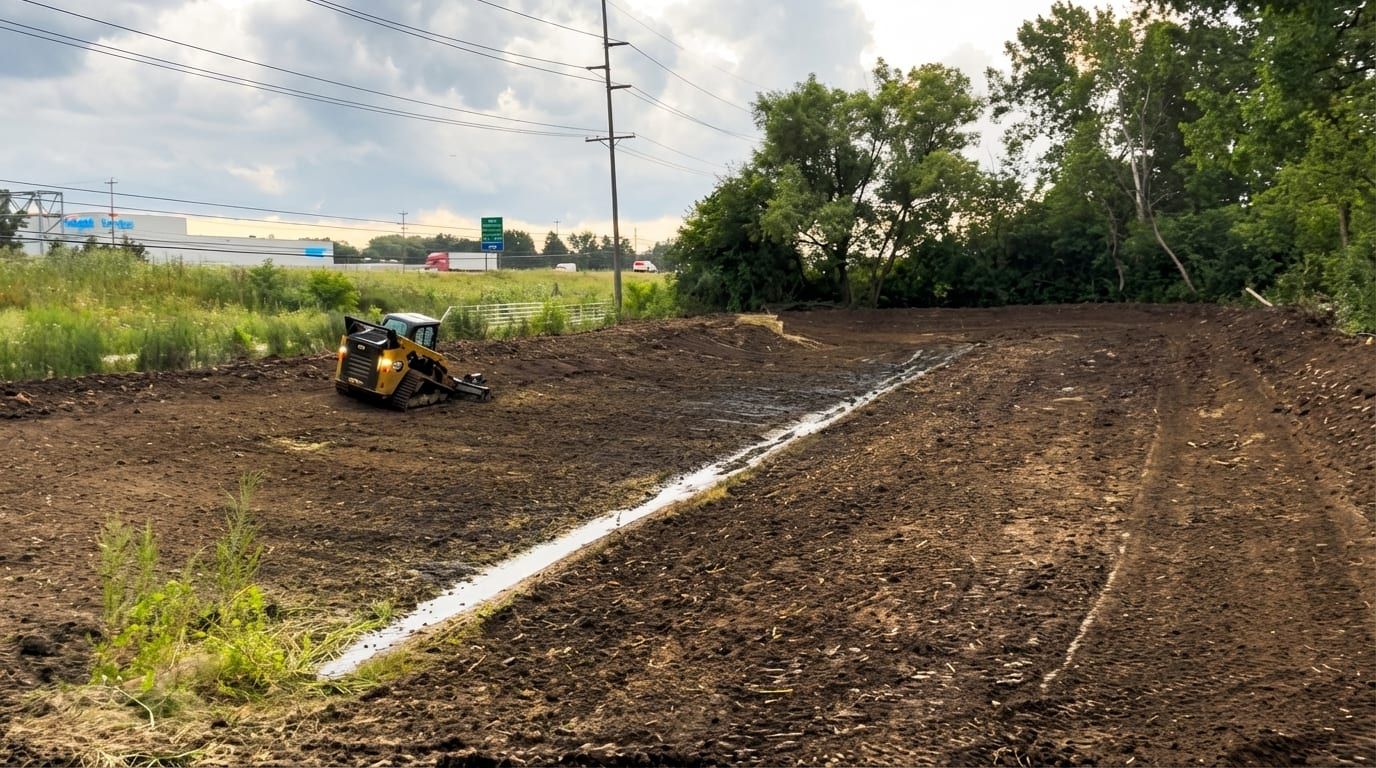
Lansing manages stormwater at a two-river confluence, with a university, a state capital, and clay soils that drain slower than most of Michigan.
Lansing sits where the Red Cedar River meets the Grand River, and that confluence shapes almost everything about stormwater management here. The Red Cedar drains a wide swath of mid-Michigan, including Michigan State University's East Lansing campus, before joining the Grand River in the capital. A heavy rain or a fast spring melt upstream on the Red Cedar shows up downstream as a river-stage problem in Lansing, on a timeline separate from whatever the Grand River itself is doing.
Michigan's regulatory structure runs through EGLE, the Department of Environment, Great Lakes, and Energy, renamed from the Department of Environmental Quality in 2019. Soil erosion and sedimentation control falls under Part 91 of NREPA, enforced locally by a county enforcing agency, in Ingham County's case the Ingham County Drain Commissioner. That office builds and maintains the county's public storm drains, administers drainage districts established under Michigan's Drain Code of 1956, and reviews Part 91 permits for earth-disturbing work. It's a structure with no real Southeastern equivalent, closer to a standing public-works authority than a permitting desk.
Inside city limits, the City of Lansing holds its own NPDES MS4 permit and has run a Combined Sewer Overflow Control Program since 1992, working to separate the city's remaining combined sanitary and storm sewers across roughly 7,000 acres in partnership with the Lansing Board of Water and Light. It's a decades-long, still-active effort, distinct from Grand Rapids' CSO program upstream, run under its own timeline and its own funding plan.
Add a third authority for campus-adjacent property: Michigan State University holds its own NPDES permit as a small MS4 operator, because roughly two miles of the Red Cedar River run through campus before reaching the Grand River. A property near MSU's East Lansing campus can sit inside city MS4 jurisdiction, county Part 91 jurisdiction, and watershed effects from campus stormwater management all at once.
- Part 91 review for earth-change work near the Grand River, the Red Cedar, or any tributary, administered by the Ingham County Drain Commissioner
- City of Lansing MS4 compliance for post-construction stormwater inside city limits, running alongside the CSO separation program
- Drainage district assessments for property inside an Ingham County drain district
- Spring flood exposure from a river system that reaches minor flood stage most years even without a major storm
The ground under Lansing behaves differently than West Michigan's sandy outwash plains, too. Much of Ingham County sits over glacial till with clay loam and silty clay loam soils, finer-textured ground that infiltrates slowly and holds water rather than shedding it. That means standing water and saturated subgrade show up as a starting condition on plenty of sites, not a symptom of something broken, and it changes how detention basins silt in, how slopes fail, and how quickly a drainage problem compounds after a storm.
What we do for Lansing and Ingham County properties.
Stormwater BMP Inspection & Maintenance
Sediment removal, outlet structure repair, and vegetation management for detention basins and BMPs across Ingham County. Clay-rich soils around Lansing hold water and pond sediment differently than West Michigan's sandy outwash, which changes how fast a basin silts in and how it needs to be inspected.
Erosion Control & Bank Stabilization
Streambank stabilization along the Red Cedar and Grand River corridors, engineered for Ingham County's clay loam and silty clay loam soils. These finer-textured soils resist erosion better than sand until they saturate, then they fail as slabs rather than gradual washout, a different repair problem than West Michigan's sandy banks.
Grading & Drainage Correction
Site regrading and drainage correction for ground that drains slowly to begin with. Much of Ingham County sits over clay-heavy till with restricted infiltration, so standing water and saturated subgrade are a starting condition here, not just a symptom of a failed system, and grading has to move water off site rather than count on it soaking in.
Storm Drainage Infrastructure
Catch basin repair, storm pipe replacement, and outfall clearing for a system still mid-separation. Lansing's CSO Control Program has been converting combined sewer segments to separate sanitary and storm lines since 1992, and properties near an active separation zone deal with shifting drainage connections as the work proceeds.
Stormwater Compliance Consulting
Sorting out obligations across the City of Lansing's MS4 permit, the Ingham County Drain Commissioner's Part 91 and drainage-district requirements, and, for campus-adjacent property, MSU's own NPDES small MS4 permit for the Red Cedar. Three overlapping authorities is more than most Michigan metros carry.
Emergency Repair
Post-flood cleanup, slope failure response, and emergency grading when spring snowmelt pushes the Red Cedar or Grand River past minor flood stage faster than a scheduled maintenance cycle can respond.
Properties we serve in the Lansing area.
Institutional & State Government Property
As Michigan's capital, Lansing carries a concentration of state government buildings and grounds with stormwater obligations tied to public infrastructure standards. Institutional campuses in the capital complex need drainage maintenance that won't disrupt public access or state operations.
University & Campus-Adjacent Property
Michigan State University's East Lansing campus straddles the Red Cedar River and runs its own NPDES stormwater program as a small MS4 operator. Property adjacent to campus, from student housing to commercial corridors along Grand River Avenue, sits inside a watershed where campus drainage decisions upstream affect downstream conditions.
HOAs & Residential Communities
Ingham County's residential growth, from East Lansing to Okemos to Delta Township, has built out stormwater detention systems on clay-heavy ground that drains slower than West Michigan's sandy soils. Boards need a maintenance schedule built around that slower infiltration, not a generic template.
Municipal & Drainage District Infrastructure
The Ingham County Drain Commissioner administers established drainage districts under the Drain Code of 1956, separate from the City of Lansing's own MS4-permitted storm system. Properties inside a drainage district face assessments distinct from city stormwater fees, and municipal contract work needs a contractor comfortable in both systems.
No yard in the capital. Just a team that already knows how this ground and this water system work.
AUE Land is headquartered in Bluffton, South Carolina, roughly a two-day drive from Lansing, and we don't have an office, a yard, or existing clients here yet. We serve Ingham County through regional dispatch, mobilizing crews and equipment on a project basis rather than pretending to a local presence that doesn't exist.
What we bring is command of a genuinely complicated regulatory picture. Three separate authorities can touch a single Lansing property: the city's MS4 permit, the Ingham County Drain Commissioner's Part 91 and drainage-district framework, and, near campus, MSU's own stormwater permit for the Red Cedar. We don't confuse those three, and we don't confuse Lansing's clay-heavy, slow-draining ground with West Michigan's sandy outwash an hour up the road.
We plan around a two-river confluence, a decades-long CSO separation program still underway, and a spring melt season that reliably pushes the Red Cedar toward flood stage before we ever think about tropical weather, because there isn't any here.
Nearby areas we serve.
About an hour northwest via the Grand River basin
Northern Michigan, roughly three hours north
Home to Michigan State University, along the Red Cedar
Eastern Ingham County suburb
South-central Michigan, upstream on the Grand River watershed
Frequently Asked Questions
Why does Lansing have two rivers to manage stormwater around? expand_more
What is Lansing's combined sewer overflow program? expand_more
Who is the Ingham County Drain Commissioner and what do they regulate? expand_more
How does the Red Cedar River flood MSU's campus and surrounding property? expand_more
Does AUE Land have local crews in the Lansing area? expand_more
Ready for a site that thrives?
Request a site assessment and we'll walk through what Part 91, your MS4 status, or a drainage district obligation actually means for your property, and what fixing it would take. No obligation to hire AUE Land for any service work.
fact_check Site Health Audit
No obligation to hire AUE Land for any service work.